Post
How to Read Tire Sidewall Markings: A Beginner’s Guide for Car Owners
Jun
How to Read Tire Sidewall Markings: A Beginner’s Guide for Car Owners
Introduction
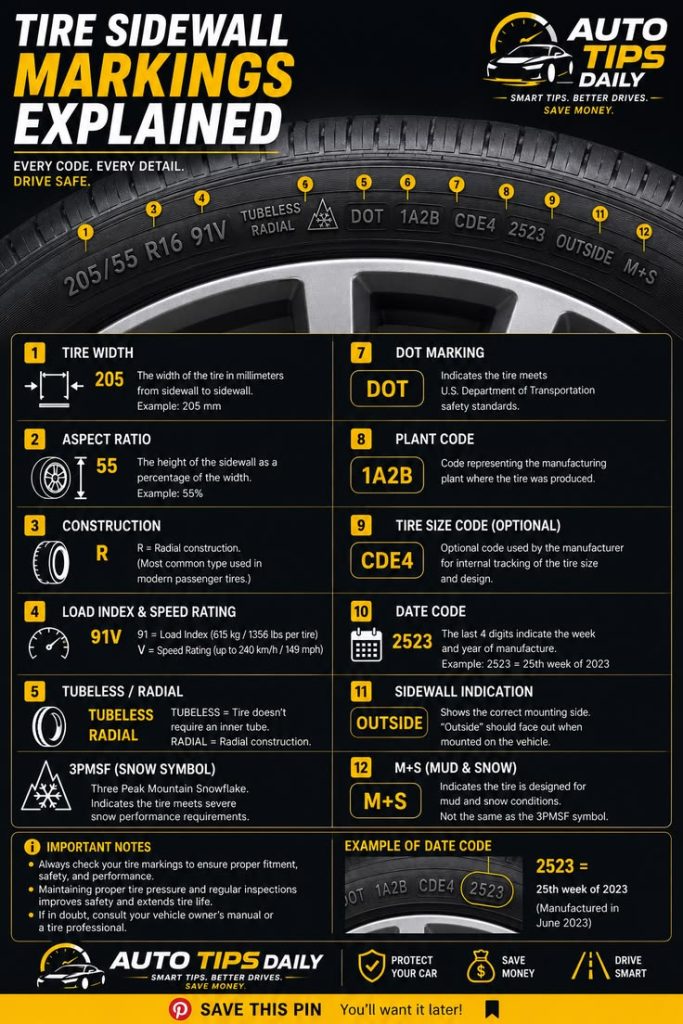
Every tire contains a wealth of information printed directly on its sidewall, yet many drivers never take the time to understand what these markings mean. From tire size and load capacity to speed ratings and manufacturing dates, these numbers and letters provide essential details that affect your vehicle’s safety, performance, and compatibility.
Whether you’re replacing worn-out tires, upgrading your wheels, or simply learning more about your vehicle, understanding tire sidewall markings can help you make informed decisions and avoid costly mistakes.
In this beginner-friendly guide, we’ll explain how to read tire sidewall markings, decode common symbols, and show you what each specification means.
Learn more about tire technology and maintenance from a leading manufacturer:
Why Tire Sidewall Markings Matter


The information printed on your tire helps ensure that you install the correct replacement and operate your vehicle safely.
Understanding these markings allows you to:
- Choose the correct replacement tire
- Verify compatibility with your vehicle
- Understand load and speed limits
- Check the tire’s manufacturing date
- Identify winter or all-season certifications
Using tires with incorrect specifications can negatively affect handling, braking, fuel efficiency, and overall safety.
Understanding a Typical Tire Size
A common tire size looks like this:
225/45 R17 94W
Each part has a specific meaning.
1. Tire Width – 225
The first number represents the tire’s width in millimeters.
Example:
225 = 225 mm wide
A wider tire generally provides:
- Larger contact patch
- Better dry-road grip
- Improved cornering stability
However, wider tires may also increase rolling resistance and slightly reduce fuel efficiency.
2. Aspect Ratio – 45
The second number indicates the tire’s height as a percentage of its width.
Example:
45 means:
Height = 45% of 225 mm
Lower aspect ratios usually provide:
- Sharper steering
- Better cornering
- Sportier appearance
Higher aspect ratios typically improve ride comfort by providing more cushioning over bumps.
3. Construction Type – R


The letter indicates tire construction.
Most modern passenger vehicles use:
R = Radial
Radial tires offer:
- Better durability
- Improved fuel efficiency
- Longer tread life
- Enhanced ride comfort
Nearly every passenger vehicle sold today uses radial tires.
4. Wheel Diameter – 17
This number indicates the wheel diameter in inches.
Example:
17 = Fits a 17-inch wheel
The wheel diameter must exactly match your vehicle’s wheel size.
5. Load Index – 94
The load index represents the maximum weight a tire can safely carry when properly inflated.
Each number corresponds to a specific load capacity according to standardized charts.
For example:
- 91 = 615 kg (1,356 lb)
- 94 = 670 kg (1,477 lb)
- 98 = 750 kg (1,653 lb)
Always choose tires that meet or exceed your vehicle manufacturer’s recommended load index.
6. Speed Rating – W
The final letter indicates the tire’s maximum certified speed under specified test conditions.
Common ratings include:
| Speed Rating | Maximum Speed* |
|---|---|
| T | 190 km/h (118 mph) |
| H | 210 km/h (130 mph) |
| V | 240 km/h (149 mph) |
| W | 270 km/h (168 mph) |
| Y | 300 km/h (186 mph) |
*These ratings indicate the tire’s tested capability, not a recommended driving speed. Always obey local speed limits and drive according to road and weather conditions.
Understanding the DOT Code


One of the most important markings is the DOT code.
Near the end of the code, you’ll find four numbers indicating when the tire was manufactured.
Example:
3524
Means:
- Week 35
- Year 2024
This indicates the tire was manufactured during the 35th week of 2024.
Checking the production date is especially useful when purchasing new tires to ensure they haven’t been stored for an extended period.
The Three-Peak Mountain Snowflake (3PMSF) Symbol
If you drive in snowy or icy climates, look for the Three-Peak Mountain Snowflake (3PMSF) symbol.
This certification indicates that the tire has met industry standards for severe snow performance.
It provides better cold-weather traction than a typical all-season tire.
M+S (Mud and Snow)
Many tires also display the marking:
M+S
This means the tire is designed for improved traction in mud and light snow compared with standard road tires.
However, M+S alone is not the same as 3PMSF certification and does not necessarily indicate the tire has passed severe snow performance tests.
Tubeless Marking
Most passenger vehicle tires include the word:
Tubeless
This means the tire does not require an inner tube.
Almost all modern passenger vehicles use tubeless tires because they:
- Reduce puncture-related air loss
- Improve safety
- Simplify repairs
- Lower maintenance requirements
Maximum Inflation Pressure
You’ll also find the tire’s maximum cold inflation pressure printed on the sidewall.
Important:
This is not the recommended everyday tire pressure for your vehicle.
Always use the tire pressure specified by your vehicle manufacturer, which is usually listed:
- On the driver’s door jamb
- Inside the fuel filler door (on some vehicles)
- In the owner’s manual
Ply Rating and Load Range
Some tires include markings such as:
- Load Range C
- Load Range D
- Load Range E
These are more common on:
- Pickup trucks
- Vans
- SUVs
- Commercial vehicles
Higher load ranges generally indicate stronger construction and greater carrying capacity.
Common Tire Sidewall Symbols
| Marking | Meaning |
|---|---|
| R | Radial construction |
| DOT | U.S. Department of Transportation compliance and manufacturing information |
| Tubeless | No inner tube required |
| M+S | Mud and Snow designation |
| 3PMSF | Certified for severe snow conditions |
| XL | Extra Load capacity |
| Run Flat | Can continue for a limited distance after a puncture (within manufacturer limits) |
Tips Before Buying New Tires
Before replacing your tires:
- Match the recommended size.
- Verify the load index.
- Check the speed rating.
- Confirm the manufacturing date.
- Choose tires appropriate for your climate.
- Buy from reputable manufacturers or authorized dealers.
Following your vehicle manufacturer’s recommendations helps maintain safety, handling, and warranty compliance.
Buying Checklist
Before purchasing new tires, make sure they:
✔ Match the recommended tire size
✔ Meet or exceed the required load index
✔ Have an appropriate speed rating
✔ Are suitable for your driving conditions
✔ Have a recent manufacturing date
✔ Include the necessary winter certifications if required
Conclusion
Reading tire sidewall markings may seem complicated at first, but each number, letter, and symbol provides valuable information about a tire’s size, construction, performance, and safety capabilities. Understanding specifications such as the tire width, aspect ratio, radial construction, wheel diameter, load index, speed rating, and DOT manufacturing date allows you to choose the correct replacement tires and maintain your vehicle’s intended performance.
By taking a few minutes to decode these markings, you’ll be better equipped to make informed purchasing decisions, ensure compatibility with your vehicle, and drive with greater confidence. Whether you’re replacing a single tire or shopping for a complete new set, knowing how to read the sidewall is an essential skill for every car owner.
